
Obituaries
Alan Montefiore obituary: philosopher who revelled in complexity
Oxford professor who applied his philosophical morals to an interrogation of his Jewish identity.
The Times
Monday December 16 2024, 5.00pm, The Times
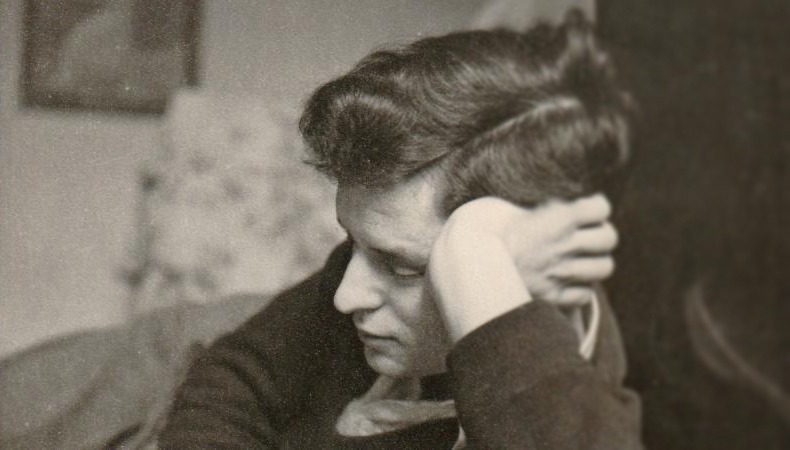
Montefiore was one of the early Anglophone analytic philosophers to take a serious interest in post-Kantian German and French philosophy
Alan Montefiore could usually be found in a roomy sweater, often reassuringly worn at the elbows, reclining in his room at the top of Staircase X in the back quad of Balliol College, Oxford. There he would be gently reminding his philosophy students of what they had meant to say, and parsing his comments — quite literally — with brackets and semi-colons.
He readily took his philosophical morals and values into the real world, but also applied them to personal relations and the interrogation of his Jewish identity. He helped to secure the Wiener Holocaust Library archives, gave underground lectures in Central and Eastern Europe, worked with Chinese philosophers, and founded the Forum for European Philosophy.
He will be remembered, above all, for his pioneering role over more than 60 years in building intellectual bridges between the Anglo-American tradition of analytic philosophy, which derives from logic and meaning, and continental philosophy, which derives from experience and reflection and places individuals and ideas in society and context. He will also be remembered as a patient and compassionate teacher and academic colleague, leading scores of students through politics, philosophy and economics (PPE) tutorials and “counter-cultural” Kant classes.
Devoted to his students, he kept notes of every essay they wrote over 50 years, and he is reputed to have scheduled tutorials with a scholarship student who was short of money at meal times so they could eat together.
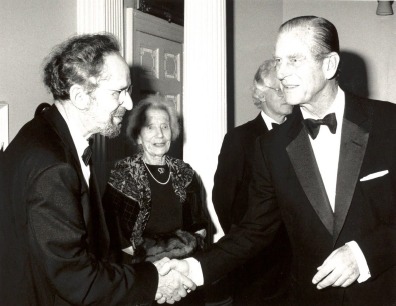
Montefiore with the Duke of Edinburgh
Alan Claude Robin Goldsmid Montefiore was born in London in 1926, the son of Leonard Montefiore, the Wiener Library’s second president and later its chairman, and grandson of Claude Joseph Goldsmid Montefiore, a past president of the Anglo-Jewish Association. He was educated at Clifton College, Bristol, attending where he attended in its separate house for Jewish boys. Here, he excelled in every sport, and this would continue throughout his life, notably in tennis and squash.
Because his beloved international cricket fixtures were put on hold during the war, he sated his love of statistics by keeping a running score of Luftwaffe aircraft shot down versus RAF ones, as reported on the radio. Montefiore did three years of National Service, principally as a soldier in Singapore, where he helped to repatriate Japanese prisoners of war. He had learned Hokkien at the London university Soas, and visiting Singapore 50 years later he astonished locals by directing them to their destination. On his return, he read PPE at Balliol College, alongside Bernard Williams and JR (John) Lucas.
Unsure what to do next, a chance offer led to a teaching post at the new Keele University in 1952, and having eased his way into teaching, he returned to Balliol in 1961 as a fellow. He was one of the early Anglophone analytic philosophers to take a serious interest in post-Kantian German and French philosophy. His Modern European Philosophy series and his Philosophy in France Today, where 11 leading contemporary French philosophers including Jacques Derrida, presented their work, stimulated the growing interest in French philosophy.
Montefiore was busy connecting “the heart of the Anglo-American philosophical empire to the barely-acknowledged and perpetually fog-bound territories of the Continent,” according to Professor Stephen Mulhall, another of his students.
In keeping with his “expansive approach”, as his Balliol colleague and former student Professor Steven Lukes termed it, he involved non-philosophers in his projects. Economists, journalists, scientists, doctors, and psychologists, all contributed to a stirring volume Integrity (1999), with a key chapter on Gert-Rudolf Flick’s donation to Oxford University, which provoked ethical questions on fundraising and the Holocaust legacy. This is also reflected in his output. He co-edited and contributed to The Political Responsibility of Intellectuals (1990); Philosophy and the Human Paradox (2019), essays on reason, truth and identity of the self; Goals, No-Goals and Own Goals (1989), debates between scientists and philosophers on intentional behaviour; and Neutrality and Impartiality (1975) on universities and political commitment and free speech, a topic that is back in the spotlight today.
A recurring theme was the notion of identity. He was uncommitted to the Jewish faith, yet carried the weight of Jewish history and his forebears, along with their community leadership and philanthropy. His father had run the Lake District camp for rehabilitating child survivors from Auschwitz.
In A Philosophical Retrospective (2011), his penultimate work, he set out to capture how far one can meaningfully know one’s own identity and the extent to which a Jew is free to be secular. He valued his regular lunches with the Oxford philosopher Isaiah Berlin. As he worked in his study he loved to polish stones. He also loved kite flying with his children. They remember his patient skill in unravelling strings so well that as the kite rose into the sky, all knots and tangles would invariably disappear. For Montefiore, however, philosophy could never be about simplifying or straightening out. He loved complexity in people as much as ideas, as Lukes put it, not to obscure but to reach further clarity. “One key lesson he taught me was the Socratic one that sometimes it is better for a dispute to continue than for either side to prevail, because of the sheer difficulty of reaching a convincing conclusion.”
At his London funeral mourners were invited to take home one of his beloved polished stones and offered Newcastle Brown Ale, his favourite tipple. This he would buy by the crate from the Balliol bar while his son would see off parking wardens at the college back gates during loading.
In his life beyond the academy he was a founding member of the Jan Hus Education Foundation, which sent philosophers to central Europe in the 1980s for underground lectures before the 1989 Velvet Revolution. In 2019, Montefiore was awarded the Czech Honorary Jan Masaryk Silver Medal.
He was founding president of the Forum for European Philosophy, housed for 25 years at the London School of Economics, making all schools of philosophy accessible to a wider public through free weekly discussions. He continued from his Singapore days working with Chinese scholars during Deng Xiaoping’s time and was an active chair of the Froebel Educational Institute council. As president of the Wiener Holocaust Library he secured its significant antisemitic document collection despite financial straits.
In 1952 he married Hélène (née Pivant), with whom he had three children: Anne, a counsellor, Claire, a psychotherapist, and Paul, a photographer and interior designer. All survive him. He loved digging holes on the beach and sledging on Boars Hill with his children. He and Hélène divorced in 1985 and he married the French political philosopher Catherine Audard, embracing her three children, Sylvain and Laure-Hélène, who both survive him, and Florence.
Montefiore had a lifelong commitment to philosophy, philanthropy, and social responsibility. On his 85th birthday, he was astounded to receive a surprise festschrift with 49 essays from former students and colleagues. He is remembered as ever curious and always calibrating the complex seams of identity — whether of a porter or professor, student or scout. He believed you could not be who you are without others. That dominated his interaction with other people because he saw everyone as essential in his, and each other’s, very identity.
He was once so caught up in a discussion while fielding on the boundary of a college cricket match, he stepped over the boundary, forgetting his duties. “I urged him back into play as he had missed a couple of balls,” recalled Paul Flather, another student. “But in reality Alan always knew his preferred and best field of play.”
Alan Montefiore, philosopher, was born on December 29, 1926. He died from a cardiac arrest on October 29, 2024, aged 97
Reproduced with the kind permission of The Times and the author (Paul Flather).
Remembering Professor Alan Montefiore
From The Wiener Holocaust Library…
Professor Alan Montefiore, a celebrated philosopher and joint president of the Wiener Holocaust Library, has died at the age of 97.
He was Emeritus Fellow of Balliol College, Oxford, and co-founder and Emeritus President of the Forum for European Philosophy.
Montefiore joined the Library’s Executive Committee in the 1970s. His father, Leonard Montefiore, had been the founding president and was described by Alfred Wiener as ‘the father of the Library’. This being the case, Alan became involved at a time where his ‘sibling’ was down at heel, stuck in a funding crisis that came extraordinarily close to being fatal.
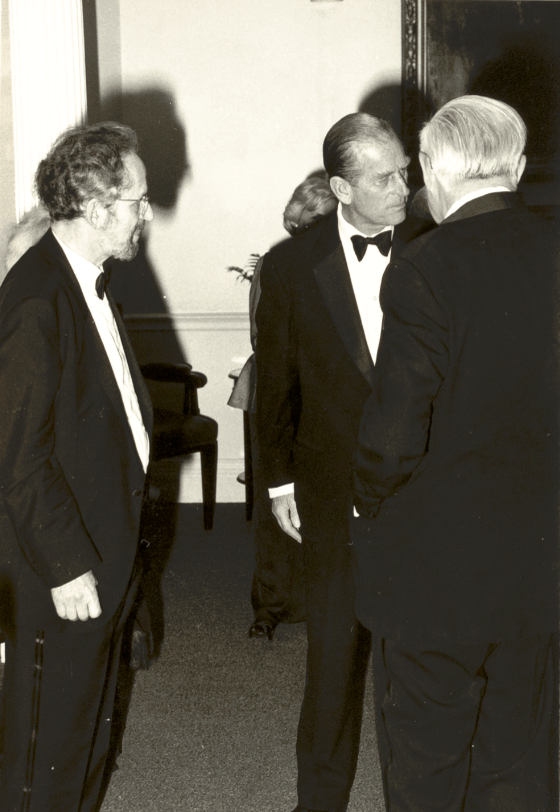
Alan Montefiore in conversation with HRH The Duke of Edinburgh and former Prime Minister James Callaghan at a fundraising dinner for the Library, November 1987
In 1980, when funding for the Library remained at a critical juncture, Montefiore was instrumental in the creation of the Wiener Library Endowment fund. His letter to former Prime Minister, and previously a devoted patron of the Library in the 1940s and 1950s James Callaghan, was met with warmth and enthusiasm. Callaghan agreed to serve as the first president of the Endowment Appeal and ‘swung into action’ gathering the great and the good to support the project.
He continued to dedicate himself to fundraising efforts to secure the future of the Library throughout this time, culminating in an impressive fundraising dinner on Whitehall attended by HRH The Duke of Edinburgh, where Montefiore proposed the toast. These philanthropic efforts were critical to the continuation of the Library into the 1990s and beyond.
The Director of the Library, Dr Toby Simpson: “Alan was a highly respected scholar and a dedicated champion of the Library at a time when very few people understood its significance, If he had not rallied other leading lights to support our work, the Library may not have survived, let alone gone on to be a world-leading public resource.”
We are grateful for Professor Montefiore’s support and stewardship of the Library and wish all those who knew him our condolences.
.