
Biography and Significant Events
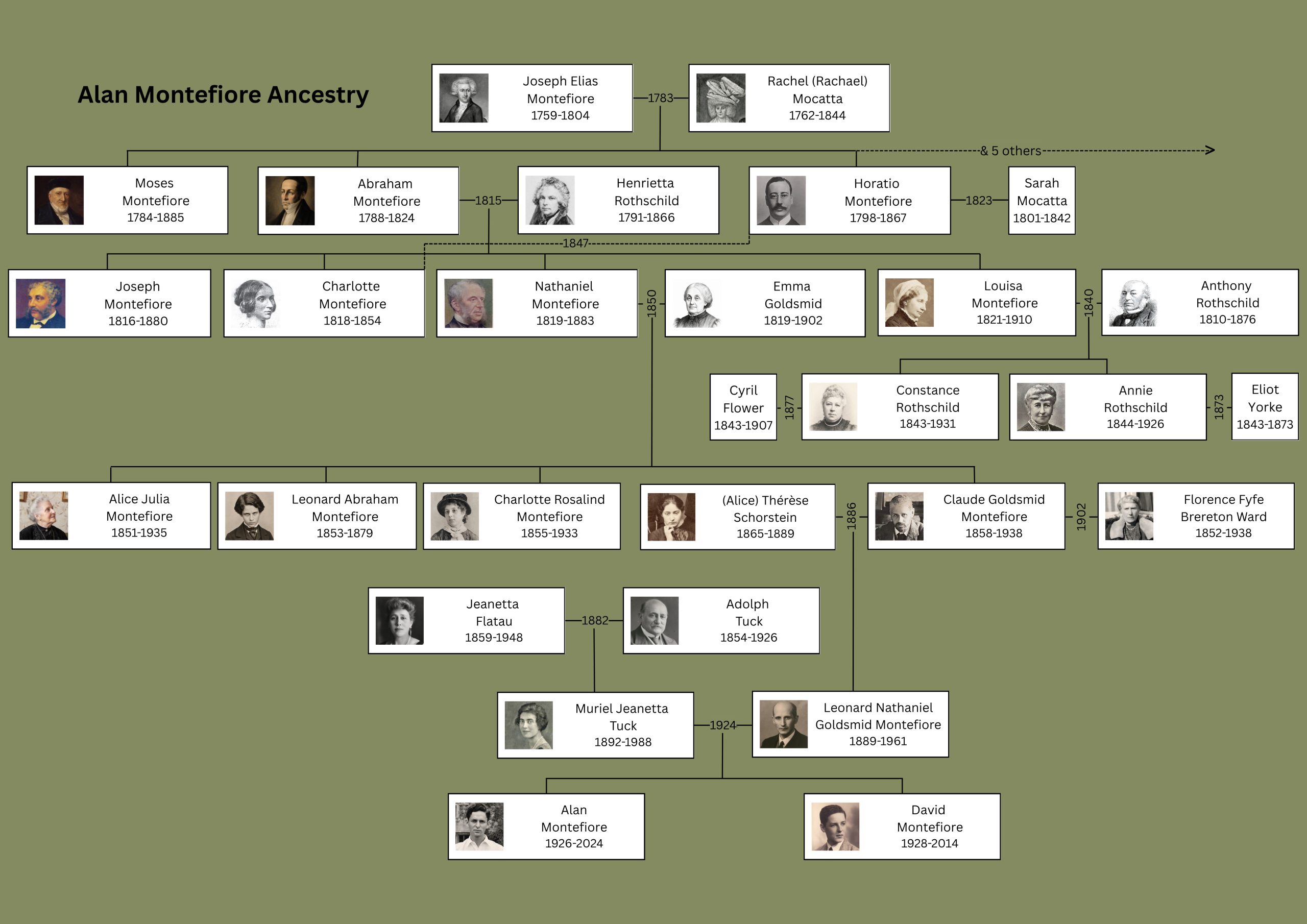
The Montefiore Family
Alan Montefiore (1926-2024) was the first in many generations of his family’s lineage to have received the entirety of his formal education, primary and secondary, in schools, rather than at home with individual tutors. This situated him on the long arc of Liberalism’s development at the point at which the project became less one defined by elites and more one concerned with individuality, where community of thought gave place to communities of thought, and independence of action and freedom permeated from the political to the personal intellectual spheres. There was something of the child left alone in a room full of sweets, giddy with the possibilities of exploring all the choices. Yet that child was always aware he needed a convincing answer should any of the previous generations of thinkers from his family enter that metaphorical room.
Alan did in many senses come from generations of thinkers, whether they were inclined to publicise their thoughts through political or social motivations, or whether they were impelled to collect and divulge their thoughts by virtue of the status of their socially ascribed position. The good fortune which Alan had was to join the succession of thinkers at a juncture which afforded a particularly privileged perspective from which to look both backwards and inwards, and forwards and outwards. The paradoxes of the human condition and the possibility of deconstructing and maybe reconstructing the very essence of identity flowed from whom Alan found himself to be, determined to sit neither on one intellectual stool or another (and fittingly always more comfortable sprawled on the floor or recumbent in an armchair with hands folded across chest to do his thinking).
Ironically the Liberal current which bore Alan’s thinking came into being from the merchant tide of Montefiore generations coming up against the conservative rock of Alan’s great-great-great-uncle, Moses Montefiore (1784-1885). To be clear, Moses would never have been aware of the existence of a ‘Liberal current’ – that is something only discernible from a much later viewpoint. Moses, like very many conservatives through time, found himself able to benefit from possibilities for social advancement which a European Liberalism – at the time unvoiced, certainly in those terms – opened up for him. Moses was instrumental in pushing at the door behind which the British social and political elite preserved their hegemony. Ideas that would develop into a long evolution of different notions of Liberal thought, and given unstoppable impetus by the revolution in France, had cracked ajar that door of closely guarded privilege. Rapidly building lucrative alliances, most beneficially with the Rothschild family, Moses amassed so much wealth as to be able to retire aged forty and lived out his remaining six decades in a succession of high-profile, and frequently international, acts of philanthropy. Sitting determinedly, but naturally, on a moral high-horse of piety and rigour, he set out to impress on the rarified aristocracy of British tradition that those of other faiths, in his case Jews, aspired to actions of equally high moral worth as those vaunted by the Protestant British nobility of the time. Making his case to a conservative nobility which needed to align with the Victorian ethos of sobriety, rigour and valour, but still in part wishing to hold back the liberal wave which threatened to impinge on traditional values, Moses somewhat unwittingly advanced the conditions which allowed a Liberal current eager to go much further in opening up social and political participation.
Moses bolstered the family’s ability to make increasingly high status alliances within elite Jewish circles and within at least the more urban, and urbane, echelons of the British establishment. Those alliances also allowed the younger, more independently disposed, and now highly educated and financially secure members of the family to become influential in the more radical and evolving domains of Liberalism. Alan’s great-great grandfather, Abraham (1788-1824), in the 36 years of his short life, succeeded in achieving great wealth through his association with his brother Moses, his marriage to Henrietta(1791-1866), daughter of Mayer Rothschild, and, of course, obsessively hard work. Meanwhile Moses and Abraham’s little brother, Horatio (1798-1867), married, in second marriage, his niece, the daughter of Abraham and Henrietta, cementing the Rothschild connection. Horatio, devoted to his faith, was also devoted to making it more relevant to how he lived it, which meant somewhat loosely. He aligned with those of his co-religionists who discerned in the modernising project of the Jewish Reform movement in Germany a means of aligning the temporal and spiritual realms they inhabited and anchoring them firmly in Britain; no longer wandering Jews, but British Jews.
All the while, the family’s Jewish identity, which Moses had at least in good part succeeded in transforming from a reason to doubt the fealty of its bearers to a proclamation of their devotion to Queen and Country, remained a badge worn proudly, alongside the badge of Britishness. Accompanying Horatio as one of the Founder Members of the British Jewish Reform movement was the patriarch of the vastly wealthy Goldsmid family, Isaac (1788-1859). Not only were (supposedly) Sephardic Montefiore’s and Ashkenazi Goldsmids now joined in a highly controversial (particularly in the eyes of Moses) mission, but the Montefiores gained an ally who was particularly active in advancing the political status of Jews and was intimately acquainted with the elite of Liberal politics.
Moreover this new connection made possible the marriage of Isaac’s formidable daughter Emma (1819-1902) with Nathaniel (1819-1883), Horatio’s nephew, Abraham’s son and Alan’s great-grandfather.
Isaac’s renown lay in his pioneering activism in the achievement of Jewish political equality and also in his relentless campaigning for the broadening and the liberalisation of education. Famously he co-founded University College London and also University College Hospital. Friends with many leading liberals and Quaker abolitionists and prison reformers, he ploughed a progressive furrow which aligned Jewish interests with a political current focused on social improvements. Perhaps even more influential, from the point of view Nathaniel’s children, was the high regard Isaac held for his daughters and the investment he made in their intellectual education. His eldest child, Anna Maria, educated to the highest level, fluent in many languages, worked as a professional translator, and also alongside her father on several of his charitable projects. A writer and campaigner in her own right, she never married, as, indeed, three of Isaac’s six daughters never did. Among her acquaintances and correspondents she counted Alexis de Tocqueville, one of who’s works she offered to translate from French to English.
Of great influence in the lives of Nathaniel’s two boys and two girls, then, were their Goldsmid mother Emma and their Rothschild aunt, Nathaniel’s sister Louisa (1821-1910), who is known for establishing the first Jewish women’s philanthropic societies. German became an important language to the children – a tradition which followed the family into the 20th Century. The four Montefiore children spent long summers with Louisa’s two children, both girls, at the Rothschild’s country properties. Constance Rothschild (1843-1931), very close to the two Montefiore boys, Leonard in particular, became widely known for her own social campaigning and fearless feminist activism. Unlike her Goldsmid cousins she chose to marry, but on the grounds of convenience only, the affable, but gay, Cyril Flower, Lord Battersea, who was quite happy not to get in the way. Leonard (1853-1879), Alan’s great uncle, and Claude (1858-1938), Alan’s grandfather, therefore found their intellectual and moral compass whilst in the presence of brilliant and thoroughly self-assured women. The legacy and responsibilities of a strong, and avowedly public, Jewish identity, together with a thoroughly progressive liberal outlook, fused with the sense of duty associated with social status and, for Leonard and Claude, the added expectations which came as bearers of a name. All four children were home tutored to the highest standards, and benefitted from loving parents, their self-assured, somewhat haughty mother balancing their genial and self-deprecating father.
The elder of the boys, Leonard, reputedly was ready with an opinion on every matter, verging on privileged arrogance until he came up against the mind-broadening reality of an education shared with peers, first at UCL and then, as soon as the final restrictions on Jewish students were dropped, at Oxford. The first of the three generations of the family to study at Balliol (his room was at the top of the tower which sits above the Broad Street entrance) he came under the influence of and became very close to the progressive Benjamin Jowett, the Master, attended Ruskin’s undergraduate breakfasts, becoming one of his most committed ‘Diggers’ and shared his time every Saturday with the men of the Jericho workhouse. Quite besotted by every beautiful girl he passed, he was nonetheless the closest of friends with Oscar Wilde and quite devoured life, socially and intellectually. The years directly after leaving Oxford with a 2nd Class in Modern History, after a year ill spent trying to convince himself he could become a barrister, Leonard devoted himself to writing articles in various periodicals and despatching letters to the Times on themes aligned with his ardently Liberal beliefs: women’s rights, social injustices and the iniquities of Bismarck’s Germany. His friends and frequent correspondents, which counted Karl Marx among them, were leading British and Continental Liberals and Radicals. In pitching the political stall which was to have seen him stand as a Liberal Party candidate in the 1880 general election, he involved himself in a very public, newspaper-letters’-page spat targeting his Rothschild uncle, Nathaniel, whom he accused of being both a bad Liberal and an indifferent Jew. Were Leonard not to have months later died of rheumatic fever in Rhode Island during a Tocquevillesque trip to study the workings of American democracy, he could quite possibly have followed a political career. He was possibly the first of the lineage to candidly set out the objective of squaring his Jewish identity with his Liberal self.
The second brother, Claude, in terms of family culture and myth making, was a great, early influence on Alan. Having cruelly inherited the position of eldest son whilst already at Oxford, where he read Literae Humaniores, or Greats, he was less well suited than his socially confident brother at assuming the limelight, but all the more intent to accept the duty his new position conferred on him. Despite sharing his father’s lack of bombast and his brother’s distaste for the self-important, he was confident in his academic ability, having always been the bookish one of the family. This by dint of being of fragile health following a serious bout of pneumonia as a child and also from having never had the social ease his brother enjoyed and which was such a valuable commodity in an environment where social connections mattered so much.
More serious in his studies than his brother and rarely leaving his Balliol study, Claude was proud to achieve the First he wanted and contemplated studying for the rabbinate. With this in mind, he set out for Germany in the company of his widowed mother and his eldest sister, Alice, for six months of study. Despite inheriting some of his mother’s social snobbery, which translated into a Tory political outlook and a fervid identification with British values, Claude’s religious beliefs had been strongly moulded at Balliol as a protégé of the Liberal Anglican theologian Jowett, and his social awareness awakened by the economic historian Arnold Toynbee, who had been a good friend of his brother’s. His experience of studying theology in Berlin was marked by his friendships with his Anglican tutors and he returned to Britain determined to advance the understanding between the Jewish and Christian faiths, a task not unconnected to his deep sense of Britishness and faithful to the long family tradition of seeking recognition as both truly British and Jewish. The consequences of Claude’s own project to accommodate his Jewish identity with his sense of a more porous belonging, produced in him a distaste for the tradition of the Jewish focus on race over religion, and similarly for the growing Zionist movement. Inexorably this would drive him to find common cause with those with whom he would help found the Liberal Synagogue in 1911, where he could be the thoroughly British Jew that he felt himself to be.
For all of his intellectual courage, Claude remained circumspect, at best, regarding his mother’s influence. Resolutely cerebral in developing his understanding of the world and his place in it, Claude did not share his brother’s predilection for expounding on the attractions of women and was more inclined to engage with them on an intellectual level. He met Alice Thérèse Schorstein (known as Thérèse, 1865-1889), the brilliant and undeniably pretty, French-born daughter of a financial editor for Reuter’s agency, when she presented herself for interview at a Jewish Freeschool for Girls for whom Claude was a governor. Thérèse had recently lost her adored father, was frustrated by her inability as a woman to find employment in line with her academic prowess and, in terms of social position and privilege, there was a clear power imbalance. These disadvantages probably compensated sufficiently for Claude’s natural timidity to allow him to be smitten by Thérèse’s impressive intellect and considerable poise. One of the first Girton College Cambridge educated women, many of whom would go on to be leading activists and suffragists, Thérèse had studied Moral Sciences, which roughly equates to studying Philosophy today. Claude’s mother, Emma, was said to be disconsolate at her only remaining son’s choice of fiancée, the daughter of émigrés of no social standing to note. Thérèse’s mother, Clara, meanwhile, was none too certain that her Orthodox daughter should be marrying a (then) Reform Jew, though the status and the wealth were redeeming features. Claude managed to hold fast in his choice but the marriage ceremony was low key. Before very long, of course, Thérèse fell pregnant, however she had already, with great pride, resumed her academic endeavours and her Prize winning essay on the Froebel education system (Froebelian education principles having been brought to Britain with the very great help of Claude) was published in the Education Journal. Tragically the union of young parents bound by intellectual passion was denied Claude and Thérèse’s son, their only child. Leonard (1889-1961), named after Claude’s big brother, lost his mother to a post-natal infection after only a week. The letter Claude wrote to his 3-week-old son is a testament to his love and admiration for a gentle but brilliant woman and remains in Leonard’s desk to this day, two generations later.
The young Leonard, motherless, was raised by governesses and by his formidable, but at least caring, grandmother, Emma. His sole playmates in lieu of siblings were his Aunt Charlotte and Sir Lewis McIver’s daughters, frequently hosted by Claude at his Sussex home. Claude formed a close friendship with Florence Brereton Ward (1852-1938), the vice-mistress of Thérèse’s old college – she had been friends with and admired Thérèse and was eager to help Claude, at a loss as a sole parent. They shared an intellectual predisposition, however she could not replace a mother, nor rekindle the rare romantic impulse Claude had felt with Thérèse. More than that, she was not a Jew. Despite converting, in her desire to do her best for Claude, Florence would have to wait until after the death of Claude’s mother Emma to become Florence Goldsmid Montefiore. Florence’s intellectual abilities she devoted to supporting her husband’s work, not to advancing her own, and to managing his household and his fragile health. Shortly after the marriage, Leonard, whom Claude knew was sorely in need of the company of other boys, was sent to Clifton College, where a Jewish ‘house’ had recently been created allowing for Jewish boys to ‘enjoy’ an education intended to nurture English gentlemen whilst continuing to follow Jewish religious practices. He was insulated, to some degree, by his social standing among the other, not dis-similarly aristocratic boys, and predominantly by the laudable Joseph Pollack, housemaster and friend of his father’s. Thus Leonard survived his boarding school experience, if not joyfully, well enough to become Head of House, gain some solid friends and later send his own sons to the same school.
From Clifton Leonard followed the family firm to Balliol, reading Modern History, like the namesake uncle he never knew. Without the enthusiastic sociability of his uncle or, despite sharing a similarly fragile health, the monkish disposition of his father, Leonard, as unathletic as either of his predecessors, nonetheless quietly thrived and made many very devoted friends, appreciative of his modesty, generosity and gentle humour. Academically he matched his uncle’s grades but not his father’s. When he emerged from university, neither highly employable nor in urgent need of employment, his father encouraged him to spend time at Toynbee Hall in the East End in order to develop his social awareness. There would have no doubt been his father’s influence, again, behind Leonard’s taking up a commission in the Army, as a manifestation of service to one’s country, a year before the outbreak of the Great War. By good fortune avoiding the European fronts (his cousin Robert Montefiore not being so lucky) the war took him to India and then to Vladivostok (originally to help evacuate the Russian Royal Family, though events took rather an unhelpful turn before the plan could be carried out). The climate shock, a 90°C temperature difference, was reputed to be behind Leonard’s early onset baldness. His WW1 ended in November 1919 after the fall of White Russian forces and earned him his OBE.
Leonard was by this time an almost over-eligible 30 years old, with a tendency towards his father’s seriousness of purpose and having to that point inhabited a fairly strenuously all-male environment. It took a little deliberate match-making by his old Clifton College schoolfriend Desmond Tuck, a recently decorated fighter pilot, to remedy the situation. Muriel (1892-1988), Desmond’s little sister, was Ashkenazi, whilst Leonard was proudly (if inaccurately) Sephardic – given the previous union of Montefiores and Goldsmids it seems ironic that this was still a subject of controversy. Muriel was just three years Leonard’s junior, already 32 at the time of their wedding. She had been – despite evidence of one or two interested parties having tried to gain her attention previously –no more inclined than Leonard to romantic liaison. Both, perhaps feeling a certain pressure to get on with things, hit it off remarkably and were devoted to each other for life. Muriel came from a fun-loving and hard-working family of very successful printers – Raphael Tuck cards continue to be collectors’ pieces for afficionados the world over. Though bright, Muriel was not an intellectual in the same mould as Leonard, less still that of her father-in-law, Claude. She served the role of traditional wife, present, but far less active in her husband’s philanthropic activities than many of the C19th Montefiore, Goldsmid and Rothschild women.
Doted on by her father-in-law, Claude, who always called her ‘Princess’, she and Leonard bridged the disconnect between her Orthodox roots and Claude’s now Liberal identification by both attending Reform services, as Leonard always had done. Leonard was gradually being prepared to inherit his father’s charitable and Jewish Community commitments. Muriel, having twice gotten through the unpleasant business of childbirth, leant her assistance to Leonard and found fresh employment for her obsessively devoted French governess as governess to her own two boys, Alan and David. The role of philanthropist and trusted Community benefactor suited Leonard well. Conservative in his political instinct like his Goldsmid grandmother, but Liberal in his social instincts like his namesake uncle, Leonard was happy to tow any middle line in terms of religious principal, for the sake of peace – in itself a Liberal motivation. Leonard was strongly influenced by his father but measured in expressing his views. His social status made him particularly aware of the tensions which existed both between his community and wider British society and within his community, and even within his extended family. He developed a mediator’s instinct. Leonard shared his father’s anti-Zionist inclination (Claude had co-founded the Anti-Zionist League of British Jews in 1917 – the year of the Balfour Declaration) and saw in the Zionist’s focus on race and nation echoes of Hitler’s obsessions in Mein Kampf. Leonard’s heritage and his temperament of observer and conciliator allowed him a particularly insightful perspective on the political developments within 1930s Europe, as did his fluency in German. Realising he was perceived as one of the de-facto guardians of the Jewish Community , he felt a special responsibility on his shoulders.
Leonard’s dislike for socialism was a natural consequence of his formative experiences. Not only did his father strongly identify with British values, but the previous two generations, Montefiore, Goldsmid and even Rothschild, had sought to emphasise the British belonging which allowed them to flourish as citizens. Socialism promised to upend the system which they had finally been accepted by; indeed it cast itself in opposition to the merchant and banker classes. Leonard inherited the principled Liberal concerns of avoiding the polarities and single group interests which could lead to violent conflict. His wartime experience in Eastern Russia, where he saw up close the cataclysm of Bolshevik revolutionary mayhem, cemented his view. The 1924 general election in which Leonard campaigned, successfully, for Winston Churchill’s return to Conservative benches, was motivated by this anti-socialism. This political statement afforded Leonard, along with some of his Community connections and good Oxford friends (Duff Cooper in particular, who like Leonard studied Modern History and became Secretary of State for War under Baldwin, First Lord of the Admiralty under Chamberlain, then Chancellor of the Duchy of Lancaster under Churchill ) valuable entries to those with political power when the need for urgent action to help German Jews accelerated. Whilst Leonard’s Wikipedia entry attests to his role in helping create the Central British Fund for German Jewry, it is quiet on his primacy in conceiving, and then doggedly coaxing through obstructive bureaucratic hoops, major projects such as the Kindertransport. Such omissions were, in this instance, of course due to so many other people also meriting credit, yet they were also down to Leonard’s natural reticence to draw attention to himself. History, however, did not neglect his leading role in enabling the rescue of the Wiener Library from Amsterdam, where it existed as the Jewish Central Information Office, bringing it to London where it now, thanks in great part to Leonard and then to Alan, thrives. Leonard is also recognised as the moving force behind the evacuation of 724 child survivors of the Holocaust to Britain in 1945, a feat now celebrated in the BBC film, The Windermere Children.
Alan inherited role models who had succeeded in establishing their Jewish credentials. What he did not inherit was their considerable wealth. That had been gainfully employed towards generations of philanthropy, virtually exhausted in the desperate and urgent task of alleviating a tiny fraction of the suffering of European Jewry before, during and immediately after the Holocaust. Wealthy Victorian families’ role in supporting charitable works had by then largely been supplanted by state aid systems brought about through progress towards a properly universal franchise. Generations had negotiated the shifting sources of authority concerned with establishing Values; from the Divine Laws which were at the forefront of Moses Montefiore’s thinking, towards the Universal Particularism which allowed Leonard and Claude, in different ways, to reconcile their convictions with their traditions using mechanisms of human reason. In Alan’s case it was not simply changes to how he might perceive the source of authority of his value choices, it was also a matter of the practical choices remaining open to him – without the financial clout of the previous generations.
In some ways this would have heightened the imperative for Alan to be clear as to what he could justly own of his cultural and ethical heritage. The choice of continuing in the same vein as his ancestors did not exist. In all events, there were some inconsistencies which would have been apparent to Alan, other than his father occasionally indulging in a surreptitious bacon sandwich. Claude’s second wife had been a convert – even if Claude had put off the official union until after his mother’s death. Alan’s first wife was also a convert, however his parents refused their personal blessing. Alan had grown up as much an English public school boy as a Jewish one. Despite being in the Jewish house at Clifton, he previously had a broadly secular prep school experience as a boarder, and being a boarder had removed him from the daily influence of home life. It was natural that he should experience a further shift in the source of authority when seeking to situate himself with regards to the value choices which manifested themselves to him. Having had a largely ‘religion-blind’ experience of Army service and University life, it was unsurprising that Alan should seek to resolve the conflicts which were lived experience for him through the device of philosophical investigation unveiled to him at Balliol. The current of Liberal thinking, which Alan joined downstream from his ancestors, demanded, as ever, a shared moral language to allow the resolution of conflicts. For Alan the journey in search of whether that moral language existed was one which involved taking up a baton passed down and along several generations.
This involved sifting through the expectations placed upon him and thoroughly assessing whether they were ones he could legitimately accept, taking into account who he considered himself to be. His grandfather and father’s association with the Froebel and the London Society for the Study of Religion, and his father’s with the Wiener Library he continued. However, the manifestly religiously defined associations, with Leo Baeck College, the Central British Fund, the Council of British Jews, and so on, he loosened the family ties with. When he judged his capacity to be useful without fear of disingenuity, Alan got involved. He was not a religious man, but he came from a tradition. The thaw in relations with his parents came too late for any of his children to meaningfully get to know their grandfather before his untimely death aged 72. However, they got to know and get close to their grandmother despite never being brought up with a shred of religious education other than the standard Anglican theology lessons of non-denominational British schools. There was no distinction in his mind between his daughters and his son as to their abilities or potential. His second wife became a leading academic philosopher in her own right, unsurprisingly a specialist in Liberal thinking. The core Liberal proposition of achieving a means of mediating between potential sources of conflict drove Alan Montefiore’s allegiances. His legacy includes the likes of the Jan Hus Educational Foundation, which supported the cultural opposition in ex-Czechoslovakia in accessing banned texts and debating ideas not permitted by the Communist state, the Forum for European Philosophy, which sought to enhance cross-disciplinary cooperation and bring philosophical thought within the reach of a broader public, and countless bridge-building projects between Continental and Anglo-American Philosophy, Western and Oriental Academics – and simply the mediation which occurs when negotiating life, conversations and the plethora of written and unwritten rules with which they are infused. Alan argued that “the strength of PPE (as originally conceived at Balliol in the 1920s) derives from an emphasis on a social constructivist, social relations approach to social and political theorising” and in ascribing to that approach Alan was able to both choose and inherit a means of apprehending and contributing to the world which had developed through many generations.
Alan Montefiore – Biography
Biography From Wikipedia
https://en.wikipedia.org/wiki/Alan_Montefiore
Alan Claude Robin Goldsmid Montefiore (29 December 1926 – 29 October 2024) was a British philosopher and Emeritus Fellow of Balliol College, Oxford.[1] He was a co-founder and Emeritus President of the Forum for European Philosophy, as well as Joint President of the Wiener Library, and a Chair of Council of the Froebel Educational Institute.[2]
Background
Montefiore was the son of Leonard Montefiore (1889–1961), who had been the Wiener Library’s second president and later its chairman.[3] He is also grandson of Claude Joseph Goldsmid Montefiore (1858–1938), a past president of the Anglo-Jewish Association. Montefiore received an Honorary Silver Medal of Jan Masaryk at the Czech Republic Ambassador’s residence in London in November 2019.[4][5]
Montefiore was born in London on 29 December 1926. He was educated at Clifton College, a boarding school with a separate house for Jewish boys. Montefiore did national service as a soldier in Singapore, where he learnt Chinese.[6][7] On his return, he read PPE at Balliol College, Oxford.
Philosophy
Writing
Montefiore’s work tended to encompass the concerns and methods of both analytic and continental philosophical traditions, covering topics in moral and political philosophy, contemporary French philosophy, and philosophy of education.
A recurring theme of Montefiore’s philosophical enquiries is the notion of identity. His philosophical arguments can be characterized as addressing four related concerns that, inevitably given his own Jewish origins, revolve around notions of Jewish identity. His book A Philosophical Retrospective[10] summarizes his thinking so that the four themes become evident. The first concerns the issue of how far it may be in anyone’s meaningful power to determine the nature and implications of their own identity—not only but especially in the case of those who may be considered by themselves or by others to be Jews. The second concerns questions of how far the possession of a Jewish identity is to be seen as bound up with a relationship to Judaism as a system of religious belief and/or practice and of what might be the longer-term prospects for a purely secular Jewish identity, whether in Israel or in the Diaspora. The third theme concerns an apparent tension between Judaism’s claim to being both a religion of universal import and yet that of a historically very particular people. The final theme is Montefiore’s personal perspective as being identified as a Jew and whether or not the possession of a Jewish identity is to be understood as carrying with it the acceptance of any particular obligations as to how to order one’s life.
For Montefiore, philosophy is a lived practice that entails “getting one’s feet wet”.[11] This led to his involvement in a number of projects and organizations dedicated to bringing philosophers into conversation with non-philosophers and to bringing philosophy beyond the academy.[7]
Montefiore was a founding member of the Jan Hus Educational Foundation, an underground education network, dedicated to providing philosophy books, seminars, and discussion groups for dissidents in then communist Czechoslovakia. The Foundation was recognized for its work by Václav Havel and, in 2019, Montefiore himself was awarded the Czech Ambassador’s Honorary Jan Masaryk Silver Medal.[12]
In 1996, in keeping with his aim to bridge the divide between analytic and continental approaches to philosophy, Montefiore co-founded the Forum for European Philosophy, currently based in the London School of Economics. He served as President until 2018, when he became Emeritus President.
References
- “Balliol College University of Oxford People”. Retrieved 20 November 2016.
- “University Lecturer Alan Montefiore, Retired Alan Claude Robin Goldsmid Montefiore”. directorstats.co.uk. Retrieved 20 November 2016.
- Barkow, Ben (1997). Alfred Wiener and the making of the Holocaust Library. London: Vallentine Mitchell. p. 104.
- Czech Embassy London Facebook post, 6 November 2019: ‘Celebrating 30th Anniversary of the Velvet Revolution and Awarding Ceremony of Jan Masaryk Silver Medal, 5th of November 2019, London – Hampstead, Ambassador´s Residence/Oslavy 30. výročí sametové revoluce a slavnostní předání Medaile Jana Masaryka, 5. listopadu 2019 v Londýně – Hampstead, rezidence velvyslance.’ accessed 10/11/2019, 10.35 GMT
- “Stříbrná medaile Jana Masaryka”.
- Stuart Brown, ed. (2005), “MONTEFIORE, Alan Claude Robin Goldsmid”, Dictionary of Twentieth-Century British Philosophers, A&C Black, pp. 692–693, ISBN 9781843710967
- Michael Rosen, MONTEFIORE, Alan (PDF)
- “Alan Claude Robin Goldsmid Montefiore”. The Times. 5 November 2024. Retrieved 8 November 2024.
- “Alan Montefiore obituary: philosopher who revelled in complexity”. The Times. 16 December 2024. Retrieved 16 December 2024.
- Montefiore, Alan (2011). A Philosophical Retrospective; facts, values and Jewish Identity. Columbia University Press. ISBN 9780231526791.
- Montefiore, Alan (2020). Philosophy and the Human Paradox: Essays on Reason, Truth, and Identity. Routledge. ISBN 9780367423117.
- “Balliol College, Oxford”. Retrieved 19 March 2021.
Royal Institute of Philosophy Discussion: Alan Montefiore and Stephen Mulhall
Biography From Grokipedai
https://grokipedia.com/page/alan_montefiore
Alan Montefiore
Alan Claude Robin Goldsmid Montefiore (29 December 1926 – 29 October 2024) was a British philosopher renowned for his work in moral and political philosophy, contemporary French thought, and the philosophy of education.[1][2]
Montefiore’s academic career spanned teaching positions at Keele University from 1952 and, most notably, as Fellow and Tutor in Philosophy at Balliol College, Oxford, from 1961 to 1994, followed by his role as Emeritus Fellow.[3][1] His tutorials in the Philosophy, Politics, and Economics (PPE) program were celebrated for their Socratic method, encouraging students to navigate complexity through self-directed inquiry under subtle guidance, with particular acclaim for his classes on Kant.[3][1] He bridged Anglo-American analytic traditions with Continental European philosophy, editing key volumes such as Philosophy in France Today (1983) and authoring works including Neutrality and Impartiality (1975), Goals, No-Goals and Own Goals (1989), The Political Responsibility of Intellectuals (1990), Integrity (1999), A Philosophical Retrospective (2011), and Philosophy and the Human Paradox (2019), which explored themes of identity, ethical responsibility, and the interplay of theory with practical life.[1]
Beyond academia, Montefiore co-founded the Forum for European Philosophy at the London School of Economics, serving as its Emeritus President, and the Jan Hus Educational Foundation in 1980 to support dissident scholars in Czechoslovakia, earning the Czech Honorary Jan Masaryk Silver Medal for his efforts in promoting academic freedom.[1][4] He was also a pivotal figure in preserving Holocaust archives as joint president of the Wiener Holocaust Library, following his father Leonard Montefiore’s legacy as its founding president; in 1980, amid a funding crisis, he established the Library’s Endowment Fund, enlisting support from figures like former Prime Minister James Callaghan and organizing high-profile events that secured its future as a leading resource on antisemitism and Nazi-era documentation.[5][1] Montefiore died of cardiac arrest at age 97, leaving a legacy of intellectual rigor applied to both abstract questions and real-world exigencies.[2]
Early Life and Education
Family and Background
Alan Montefiore was born Alan Claude Robin Goldsmid Montefiore on 29 December 1926 in London, into a prominent Anglo-Jewish family with deep roots in philanthropy and intellectual pursuits.[6] His father, Leonard Montefiore (1889–1961), served as the founding president of the Wiener Library, the world’s oldest collection dedicated to the documentation of Nazi persecution and the Holocaust, reflecting the family’s commitment to preserving Jewish history and combating antisemitism.[1] As the eldest son, Montefiore grew up in an environment shaped by this heritage, which emphasized self-aware Jewish identity amid broader societal challenges.[7]
Montefiore’s paternal grandfather, Claude Joseph Goldsmid Montefiore (1858–1938), was a leading Jewish theologian and liberal reformer who founded the Liberal Jewish movement in Britain and advocated for ethical interpretations of Judaism influenced by biblical criticism.[1] The family traced its lineage to the illustrious 19th-century philanthropist Sir Moses Montefiore (1784–1885), whose efforts on behalf of oppressed Jews worldwide established the Montefiore name as synonymous with Jewish advocacy; Montefiore himself was a direct descendant of Moses Montefiore’s great-nephew.[8] This background instilled in him an early awareness of dual identities—personal Jewish heritage versus philosophical inquiry—amid the interwar period’s rising tensions in Europe, though specific details of his immediate family dynamics, such as siblings or maternal lineage, remain less documented in available records.[9]
Formal Education and Influences
Montefiore attended Clifton College in Bristol from 1941 to 1945, studying in the school’s dedicated house for Jewish boys, where he excelled in sports such as tennis and squash and took an interest in international cricket.[10][1]
After completing his secondary education, he undertook national service in Singapore, contributing to the repatriation of Japanese prisoners of war following World War II.[1] He subsequently enrolled at Balliol College, Oxford, to read Philosophy, Politics, and Economics (PPE), earning a Bachelor of Arts in 1950 and a Master of Arts in 1957.[10][1]
During his Oxford studies in the late 1940s, Montefiore was introduced to core philosophical concerns, including the distinction between facts and values, which shaped his early analytical approach.[11] His family’s prominent Jewish heritage—marked by his father Leonard Montefiore’s founding presidency of the Wiener Library and his grandfather Claude Joseph Goldsmid Montefiore’s leadership in the Anglo-Jewish Association—profoundly influenced his thinking on identity, morality, and community, fostering a synthesis of Anglo-American logic-based philosophy with European reflective traditions.[1] Experiences from national service further informed his later explorations of practical ethics and cross-cultural engagement.[1]
Academic Career
Positions at Oxford University
Prior to his Oxford positions, Montefiore held teaching positions at Keele University from 1952 to 1961.[1] Alan Montefiore held the position of Fellow and Tutor in Philosophy at Balliol College, Oxford University, from 1961 to 1994.[3] In this role, he contributed to the college’s tutorial system, providing individualized instruction in moral and political philosophy to undergraduates.[3] Following his retirement in 1994, Montefiore was elected Emeritus Fellow of Balliol College, a status he maintained until his death in 2024, allowing continued association with the institution and participation in its intellectual life.[3] These positions anchored his academic career at Oxford, where Balliol’s emphasis on rigorous philosophical inquiry aligned with his interests in ethical theory and self-examination.[3] No other formal university-wide professorships or departmental chairs at Oxford are recorded for Montefiore, with his influence primarily exercised through Balliol’s collegiate framework.[3]
Teaching and Mentorship
Montefiore held the position of Fellow and Tutor in Philosophy at Balliol College, Oxford, from 1961 to 1994, after which he became an Emeritus Fellow.[3] In this capacity, he played a central role in the college’s Philosophy, Politics, and Economics (PPE) program, engaging students through the intensive Oxford tutorial system that emphasized one-on-one or small-group discussions to foster critical thinking and argumentative rigor.[3] His tutorials, often conducted in his office in Staircase 10, were remembered for their depth and intellectual stimulation, contributing to Balliol’s reputation for producing influential thinkers in philosophy and related fields.[3]
Montefiore’s teaching focused on core philosophical texts and methods, with his classes on Immanuel Kant particularly renowned for their clarity and insight into complex ethical and metaphysical issues.[3] He bridged analytical philosophy—prevalent at Oxford during his early career—with continental traditions, encouraging students to grapple with self-examination and the nuances of moral reasoning rather than reductive simplifications.[12] This approach influenced generations of undergraduates, as evidenced by tributes describing him as an inspirational guide who prioritized philosophical complexity over dogmatic conclusions.[13]
His mentorship extended beyond formal tutorials, shaping colleagues and successors through collaborative intellectual environments at Balliol.[3] In recognition of this legacy, Balliol established the Alan Montefiore Fund in 2024, offering grants of up to £5,000 to students and early-career fellows pursuing research in areas aligned with his interests, such as ethics and philosophical inquiry into identity and responsibility.[14] This initiative underscores the enduring impact of his teaching on fostering independent scholarship at the college.[14]
Philosophical Contributions
Moral and Ethical Philosophy
Montefiore’s early engagement with moral philosophy centered on analytic clarification of foundational concepts, as detailed in his 1958 monograph A Modern Introduction to Moral Philosophy. There, he systematically examines the meaning of calling something “good,” arguing that this inquiry inevitably extends to broader issues of value judgments and their logical structure.[15] He employs modern philosophic analysis to probe whether value judgments constitute verifiable statements akin to factual assertions or possess a distinct character, questioning if values can be treated as objective properties independent of human appraisal.[15]
A core concern in this work is the relationship between moral obligation and descriptive reality, particularly the classic divide between “is” and “ought.” Montefiore explores how imperatives of duty arise, assessing the possibility of genuine errors in moral reasoning and the implications for ethical deliberation, while cautioning against reductive accounts that overlook the nuanced interplay of language and commitment in ethics.[15] This approach introduces students to philosophy not through historical summaries but via active analysis, emphasizing precision in dissecting ethical claims to reveal their underlying assumptions.[16]
In later writings, Montefiore extended these themes to interrogate the inference from facts to values, resisting any facile derivation of ethical norms from empirical data alone. In A Philosophical Retrospective: Facts, Values, and Jewish Identity (2010), he contends that indisputable factual identities—such as ethnic or historical affiliations—do not automatically entail specific value commitments, highlighting a persistent gap that demands individual reflective judgment rather than deterministic entailment.[9] This perspective underscores his advocacy for “value individualism,” wherein individuals bear ultimate, irreducible responsibility for selecting or shaping their values amid ethical complexity, critiquing oversimplified frameworks that attribute moral stances to unchosen determinants.[17]
Montefiore’s ethical philosophy thus privileges rigorous scrutiny over dogmatic resolution, integrating analytic rigor with sensitivity to human agency and the irreducibility of moral choice. His essays in Philosophy and the Human Paradox: Essays on Reason, Truth and Identity (2019) further apply this to the formation of self through ethical reasoning, portraying morality as intertwined with personal identity yet not reducible to causal or empirical necessities. Throughout, he maintains that ethical inquiry thrives on embracing paradoxes—such as the tension between objective truth claims and subjective valuation—rather than resolving them prematurely, fostering a philosophy attuned to the demands of authentic moral responsibility.
Engagement with French and Continental Thought
Montefiore’s engagement with French and continental philosophy primarily involved efforts to mediate between Anglo-American analytic traditions and the diverse strands of post-war European thought, particularly existentialism, phenomenology, and hermeneutics. He edited Philosophy in France Today (Cambridge University Press, 1983), a volume featuring essays by prominent French thinkers including Jacques Derrida, Michel Foucault, Paul Ricoeur, Emmanuel Levinas, and Jean-François Lyotard, aimed at presenting their ideas to an English-speaking audience skeptical of non-analytic approaches. This work highlighted Montefiore’s interest in thinkers who emphasized historical context, ethical responsibility, and interpretive methods over formal logic, contrasting with the prevailing Oxford emphasis on linguistic analysis during his career.[18]
In his essay “The ‘Continental’ Tradition?” (published in the Royal Institute of Philosophy Supplements, 2014), Montefiore argued against treating “continental philosophy” as a monolithic entity, describing it instead as a “discordant family of notably distinct traditions” shaped by differing responses to modernity, rather than a coherent alternative to analytic philosophy.[19] This reflected his broader critique of the analytic-continental divide, which he viewed as rooted in mutual misunderstandings rather than irreconcilable methodologies; he contended that both could inform ethical inquiry, particularly in addressing personal relations and moral agency.[20] Montefiore also co-edited Philosophy and Personal Relations: An Anglo-French Study (Routledge, 1973), juxtaposing British philosophers like R. S. Downie with French perspectives influenced by Sartre and Levinas to explore how cultural differences affect conceptions of autonomy and interpersonal ethics.[21]
Throughout his career, Montefiore responded to French existentialism—particularly Sartre’s emphasis on freedom and bad faith—by integrating its themes into discussions of self-examination and historical responsibility, as seen in post-1945 British philosophical debates at institutions like Oxford.[22] His retrospective reflections, such as in A Philosophical Retrospective (Columbia University Press, 2010), underscored attempts to reconcile these influences with analytic rigor, prioritizing practical ethical insights over ideological opposition, though his focus on “foreign” thinkers was occasionally dismissed as peripheral in analytic circles.[7] This bridging role extended to institutional initiatives, including co-founding the Forum for European Philosophy at the London School of Economics in 1996, which facilitated dialogue on continental themes like Levinas’s ethics of the Other within analytic frameworks.[20]
Themes of Philosophical Self-Examination
Alan Montefiore’s exploration of philosophical self-examination centers on the moral imperative to achieve a coherent “self-reality,” which he posits as essential for genuine self-respect and ethical respect toward others. In his 1978 essay, Montefiore argues that self-reality demands a rigorous interrogation of one’s identity and actions to discern authentic commitments from self-deceptive projections, framing this as a foundational ethical task that underpins integrity.[23] This process involves ongoing introspection to align personal agency with moral demands, avoiding the fragmentation that arises from unexamined inconsistencies between professed values and lived conduct. He connects this to broader ethical theory, suggesting that without such self-scrutiny, individuals risk undermining their capacity for respectful interpersonal relations, as self-respect serves as a prerequisite for recognizing others’ autonomy.[24]
Montefiore extends these themes to personal and cultural identity, particularly in his reflective 2010 monograph A Philosophical Retrospective: Facts, Values, and Jewish Identity, where he examines the tensions between factual self-ascriptions—such as Jewish heritage—and normative obligations derived from communal or familial expectations. Through autobiographical philosophical analysis, he questions whether empirical facts of identity inherently impose values, subjecting his own secular leanings to scrutiny against traditional Jewish particularism and historical impositions like Nazi racial criteria.[9] This self-examination reveals the limits of rational resolution in identity conflicts, highlighting philosophy’s role in clarifying conceptual frameworks rather than dictating outcomes, and underscoring the paradox of seeking self-determined identity within socially embedded forms of life.[9]
In later works, such as essays compiled in Philosophy and the Human Paradox (2019), Montefiore emphasizes philosophy’s contribution to self-formation through critical engagement with reason, truth, and identity paradoxes, advocating introspective methods that foster awareness of the self’s relational and historical contingencies without presuming universal resolutions. These themes collectively portray self-examination not as an abstract exercise but as a practical moral and existential necessity, grounded in Montefiore’s Wittgenstein-influenced view that meaning and authenticity emerge from communal yet individually reflective practices.[9]
Publications and Writings
Key Monographs and Edited Volumes
Alan Montefiore’s monograph A Modern Introduction to Moral Philosophy, first published in 1958 by the Cresset Press and later reissued by Routledge, offers an accessible entry into mid-20th-century analytic moral philosophy, emphasizing linguistic analysis and the clarification of ethical concepts through ordinary language examination.[25] The work critiques traditional ethical theories while highlighting the limitations of emotivism and prescriptivism, drawing on influences from J.L. Austin and G.E.M. Anscombe to argue for a nuanced understanding of moral reasoning grounded in practical discourse.[26]
In A Philosophical Retrospective: Facts, Values, and Jewish Identity (Columbia University Press, 2011), Montefiore examines the interplay between empirical facts and normative values, particularly through the lens of Jewish identity and historical events like the Holocaust, advocating for a philosophical approach that integrates self-examination with communal responsibility.[7] The book synthesizes decades of his reflections, challenging positivist separations of fact and value by demonstrating how personal and collective identities shape ethical judgments.[27]
Among his edited volumes, Philosophy and Personal Relations: An Anglo-French Study (McGill-Queen’s University Press, 1973; Routledge revival 2021) compiles contributions from philosophers on both sides of the Channel, addressing how philosophical inquiry intersects with interpersonal ethics, deception, and the treatment of persons.[28] Montefiore’s introduction frames the dialogue, questioning whether analytic precision can reconcile with phenomenological insights into relational dynamics.[29]
Philosophy in France Today (Cambridge University Press, 1983), edited by Montefiore, presents essays from prominent French thinkers including Jacques Derrida, Jean-Toussaint Desanti, and Vincent Descombes, offering English readers direct engagements with structuralism, post-structuralism, and contemporary phenomenology.[18] The volume underscores Montefiore’s role in bridging Anglo-American and continental traditions, with contributions exemplifying methodological shifts in French philosophy during the late 20th century.[30]
Montefiore also edited The Political Responsibility of Intellectuals (Harvester Wheatsheaf, 1990), stemming from a 1988 Oxford conference, which explores intellectuals’ obligations in public discourse, featuring analyses of figures like Noam Chomsky and Jürgen Habermas alongside critiques of ideological neutrality. This work reflects his interest in applied ethics, emphasizing accountability amid political engagement.
Other key monographs include Neutrality and Impartiality (1975), Goals, No-Goals and Own Goals (1989), Integrity (1999), and Philosophy and the Human Paradox (2019).[1]
Contributions to Journals and Broader Impact
Montefiore published articles across professional philosophical journals, addressing themes in moral deliberation, self-identity, and ethical education. In 2009, he contributed “Deliberate Wrong-Doing” to Think, questioning the possibility of intentional acts known to be morally erroneous, drawing on psychological and philosophical analyses of akrasia.[31] His 1978 paper “Self-Reality, Self-Respect, and Respect for Others,” in the Proceedings of the Aristotelian Society supplementary volume, analyzed how self-conception underpins mutual ethical regard, integrating analytic rigor with existential concerns.[23]
In moral education, Montefiore’s 1979 article “Philosophy and Moral (and Political) Education” in the Journal of Philosophy of Education critiqued divergent moral foundations—consequentialist versus deontological—and their pedagogical ramifications, advocating reflective practices over dogmatic instruction.[32] He contributed to Inquiry in 1966 on themes in British analytical philosophy, shaping mid-20th-century debates on linguistic and conceptual analysis in ethics.[33]
These journal works exerted broader influence by bridging analytic precision with continental emphases on lived experience, informing discussions on moral philosophy’s public role. For instance, Montefiore’s reflections on Holocaust comprehension from a moral philosopher’s viewpoint, published in ethical forums, highlighted limits of empathetic understanding in historical evil, impacting Jewish philosophical identity discourse.[34] Steven Lukes credits Montefiore’s essays with deepening analyses of contested concepts like power and individualism, extending analytic tools to socio-political critique.[17] His publications in outlets like Mind further underscored human paradoxes in reason and truth, fostering interdisciplinary applications in education and self-examination.[35]
Institutional and Public Engagement
Roles in Philosophical Forums
Alan Montefiore co-founded the Forum for European Philosophy in 1996, serving as its founding president and later as Emeritus President, with the organization initially housed at the London School of Economics for 25 years to promote dialogue across philosophical traditions, including analytic and continental approaches.[2][35] The Forum organized public lectures, seminars, and events emphasizing European philosophical thought, reflecting Montefiore’s interest in bridging divides between schools like Anglo-American and French philosophy, and it celebrated its tenth anniversary in 2006 with a conference honoring his contributions.[35][7
]Montefiore’s leadership extended to fostering interdisciplinary engagement, as evidenced by his role in events such as discussions at the Royal Institute of Philosophy, where he contributed to broadcasts on topics like philosophical self-examination in 2018.[36] Through these forums, he emphasized complexity in moral and ethical reasoning, avoiding reductive simplifications in favor of nuanced, self-reflective inquiry across diverse intellectual traditions.[1] His emeritus status post-retirement from Balliol College underscored a continued commitment to public philosophy, influencing generations of scholars via the Forum’s sustained activities until its relocation.[37]
Involvement with Jewish and Holocaust Institutions
Alan Montefiore served as joint president of the Wiener Holocaust Library, the world’s oldest institution dedicated to the study of the Holocaust and genocide, contributing to its preservation and educational mission.[5] In 1980, amid a funding crisis, he established the Library’s Endowment Fund, enlisting support from figures including former Prime Minister James Callaghan and organizing high-profile events that secured its future.[5][1] In this role, he played a key part in securing the library’s archives, ensuring the safeguarding of historical documents related to Nazi persecution and the Holocaust.[1] His involvement extended to broader advocacy, including delivering underground lectures on philosophical topics in Central and Eastern Europe during periods of political restriction as part of supporting academic freedom.[2]
Montefiore’s engagement with Holocaust-related themes was informed by his philosophical work on moral responsibility and historical comprehension, as explored in his essay “The Moral Philosopher’s View on the Holocaust,” where he examined the limits of philosophical understanding in grasping the event’s ethical dimensions without direct experience.[34] Despite not being religiously observant, he acknowledged the enduring influence of Jewish historical burdens on his identity, stemming from his family’s prominence in Anglo-Jewish communal leadership, which shaped his commitment to institutions preserving Holocaust memory.[2] This perspective informed his support for the Wiener Library’s role in countering denialism and fostering critical reflection on genocide.[5]
No records indicate formal leadership in other Jewish organizations beyond his Wiener Library presidency, though his early education at Clifton College’s house for Jewish boys exposed him to communal Jewish environments.[1] His contributions emphasized intellectual and archival stewardship over organizational activism, prioritizing the philosophical interrogation of identity and atrocity in institutional settings.[27]
Legacy and Assessments
Academic Influence and Reception
Montefiore’s academic influence stemmed primarily from his long tenure as a tutor in philosophy at Balliol College, Oxford, from 1961 to 1994, where he shaped generations of students in the Politics, Philosophy, and Economics (PPE) program through personalized tutorials and renowned classes on Immanuel Kant.[3][1] Colleagues such as Sudhir Hazareesingh described him as “the life and soul of Balliol PPE,” noting his compassionate approach, including maintaining detailed records of student essays over five decades and accommodating tutorials during mealtimes for those in need.[3][1] His teaching emphasized guiding students to pursue individual interests while fostering intellectual rigor, contributing to his reputation as a dedicated mentor rather than a prolific generator of disciples.[2]
In broader philosophical circles, Montefiore exerted influence by bridging Anglo-American analytic traditions with continental European thought, particularly post-Kantian German and French philosophy, at a time when such engagement was uncommon in Oxford.[2] He edited key volumes like Philosophy in France Today (1983), featuring contributions from figures such as Jacques Derrida, which introduced French ideas to English-speaking audiences and stimulated interest in continental philosophy.[2] His co-founding of the Forum for European Philosophy in 1996 further extended this reach, hosting public discussions at the London School of Economics for over 25 years to democratize philosophical discourse.[2][1]
Reception of Montefiore’s work highlighted its complexity and integrative depth, with peers like Steven Lukes praising his resistance to simplification in ethical and political analysis.[2] Stephen Mulhall, one of his students, commended his efforts to connect disparate traditions, while a festschrift presented on his 85th birthday in 2011 compiled 49 essays from contributors across disciplines, underscoring enduring respect.[2] Though his output focused on monographs like Neutrality and Impartiality (1975) and Philosophy and the Human Paradox (2019) rather than high-volume citations, his legacy endures through initiatives such as the Jan Hus Educational Foundation, which delivered underground philosophy lectures in 1980s Eastern Europe, earning him the Czech Honorary Jan Masaryk Silver Medal in recognition of intellectual solidarity.[1] Balliol’s establishment of the Alan Montefiore Fund post-retirement supports ongoing philosophical inquiry, affirming his foundational role in the college’s tradition.[14]
Criticisms and Debates
Montefiore’s engagement with Richard Rorty’s Philosophy and the Mirror of Nature (1979) highlighted tensions between analytic and continental philosophical traditions, with Montefiore arguing that Rorty’s text exhibited inconsistencies akin to “two philosophers” at work—one advancing a critique of foundationalism and another defending conversational pragmatism without sufficient rigor.[38] In response, Rorty conceded points on the book’s construction while defending its rejection of philosophy as a mirror of nature, acknowledging Montefiore’s valid challenge to equating abnormal discourse with ironism.[39] This exchange underscored broader debates on philosophy’s boundaries, where Montefiore emphasized the need for self-critical examination over Rorty’s edifying reinterpretation.
As editor of Neutrality and Impartiality: The University and Political Commitment (1975), Montefiore facilitated discussions on whether academics could maintain detachment amid political pressures, critiquing simplistic notions of neutrality as incompatible with value-laden inquiry. Contributors like Leszek Kolakowski debated Montefiore’s framework, arguing that true impartiality requires substantive moral commitments rather than procedural detachment alone, influencing later analyses of university roles in ideological contexts.[40] Some evaluations have faulted Montefiore’s approach for over-relying on rule-based neutrality, neglecting deeper background assumptions in ethical decision-making.[41]
Montefiore’s later reflections on philosophy’s limits in resolving factual and value disputes, particularly in Jewish identity and self-examination, drew scrutiny for implying an irresolvable pluralism that undermines rational adjudication.[9] He rejected philosophy as a singular arbiter, favoring ongoing self-critique, a stance echoed in democratic theory but debated for potentially fostering relativism over principled consensus.[42] These positions, while praised for embracing complexity, faced implicit pushback in analytic circles for prioritizing continental-style reflexivity over empirical resolution.[2]
References
- https://www.thejc.com/news/obituaries/celebrated-philosopher-and-champion-of-the-wiener-library-alan-montefiore-dies-at-97-a0cf4wmd
- https://www.thetimes.com/uk/obituaries/article/alan-montefiore-obituary-philosopher-who-revelled-in-complexity-dfxmj2bbb.
- https://www.balliol.ox.ac.uk/news/2024/november/alan-montefiore-1926-2024
- https://www.balliol.ox.ac.uk/news/2020/may/restoring-scholarship-and-academic-freedom-in-the-czech-and-slovak-nations
- https://wienerholocaustlibrary.org/2024/11/29/remembering-professor-alan-montefiore/
- https://www.oxfordreference.com/display/10.1093/oi/authority.20110803100207522?p=emailA0T33bCNSLAcs&d=/10.1093/oi/authority.20110803100207522&print
- https://cup.columbia.edu/book/a-philosophical-retrospective/9780231153003
- https://jewishreviewofbooks.com/articles/135/jewish-identity-and-its-discontents/
- https://ndpr.nd.edu/reviews/a-philosophical-retrospective-facts-values-and-jewish-identity/
- https://prabook.com/web/alan_claude.montefiore/644305
- https://cupblog.org/2011/04/06/interview-with-alan-montefiore-author-of-a-philosophical-retrospective/
- https://cdnc.heyzine.com/flip-book/pdf/7d9ac896c578633e6038d44fc1b1211d8466a5ec.pdf
- https://www.yumpu.com/en/document/view/3766538/news-balliol-college-university-of-oxford
- https://give.balliol.ox.ac.uk/p/alanmontefiore/
- https://www.taylorfrancis.com/books/mono/10.4324/9781003049517/modern-introduction-moral-philosophy-alan-montefiore
- https://www.cambridge.org/core/services/aop-cambridge-core/content/view/C90FFF9D4514447D0BBB8CCFA7199E51/S0031819100037815a.pdf/ modern_introduction_to_moral_philosophy_by_alan_montefiore_routlege_and_kegan_paul_ 1958_pp_vii_213_price_14s.pdf
- https://stevenlukes.net/wp-content/uploads/2012/07/9-alan-montefiore-an-appreciation.pdf
- https://www.amazon.com/Philosophy-France-Today-Alan-Montefiore/dp/0521296730
- https://www.cambridge.org/core/journals/royal-institute-of-philosophy-supplements/article/continental-tradition/2B026F856DC97D02A29180F9FD100F49
- https://www.taylorfrancis.com/books/mono/10.4324/9780367853488/philosophy-human-paradox-danielle-sands-alan-montefiore
- https://www.scribd.com/document/927762187/Philosophy-and-Personal-Relations-An-Anglo-French-Study-Alan-Montefiore-Editor-pdf-version
- https://www.tandfonline.com/doi/abs/10.1080/17496977.2019.1651128
- https://onlinelibrary.wiley.com/doi/abs/10.1111/j.1475-4975.1978.tb00357.x
- https://philpapers.org/rec/MONSSA-4
- https://www.abebooks.co.uk/Modern-Introduction-Moral-Philosophy-Alan-Montefiore/32342378554/bd
- https://philpapers.org/rec/MONAMI-7
- https://books.google.com/books/about/A_Philosophical_Retrospective.html?id=blHWDzohfzMC
- https://www.routledge.com/Philosophy-and-Personal-Relations-An-Anglo-French-Study/Montefiore/p/book/9780367682828
- https://www.ebay.com/itm/146305839379
- https://philpapers.org/rec/MONPIF-7
- https://www.cambridge.org/core/journals/think/article/deliberate-wrongdoing/D5585EC227ACD667D212886183145620
- https://academic.oup.com/jope/article/13/1/21/6900756
- https://www.tandfonline.com/doi/abs/10.1080/00201746608601474
- https://www.jstor.org/stable/41444278
- https://academic.oup.com/mind/article-abstract/133/529/276/6446142
- https://www.youtube.com/watch?v=jeZAXMaOZ3o
- https://blogs.lse.ac.uk/theforum/montefiore/
- https://www.analyse-und-kritik.net/Dateien/56c31da0f0ce1_ak_montefiore_1983.pdf
- https://www.analyse-und-kritik.net/Dateien/56c31b3cb2eed_ak_rorty_1984.pdf
- https://www.jstor.org/stable/20019390
- http://drmahmoudi.com/home/en-pdf/9008en.pdf
- https://eprints.lse.ac.uk/112949/1/MIND_Montefiore_Review_Revised.pdf